
Internal Family Systems (IFS) Therapy in Santa Monica, CA
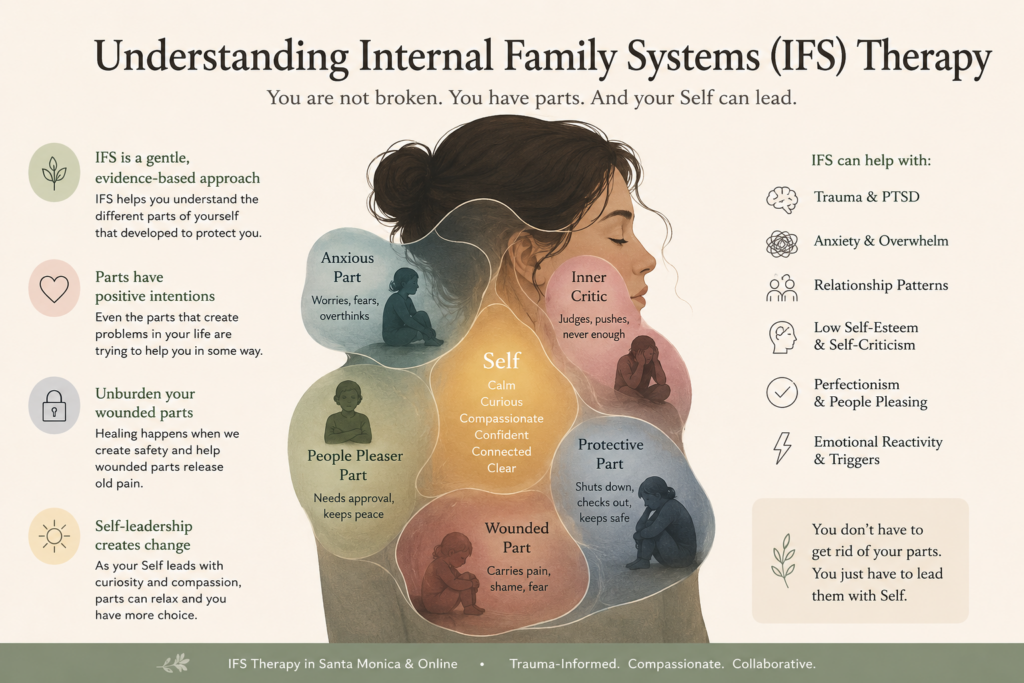
Internal Family Systems (IFS) therapy is a trauma-informed approach that helps you understand the protective, vulnerable, and reactive parts of yourself that influence your emotions, relationships, and behavior. Rather than trying to eliminate these parts, IFS helps you understand why they developed and relate to them with greater curiosity, compassion, and Self-leadership.
You may understand your patterns but still feel stuck in them
You might know exactly why you people-please, overthink, shut down, become anxious in relationships, or push yourself relentlessly—and still find yourself doing the same thing.
That can be frustrating, particularly if you have already spent time in therapy and have a lot of insight.
Internal Family Systems offers a different way of understanding these patterns. Instead of seeing them as flaws that need to be corrected, IFS looks at them as parts of you that developed for a reason.
A perfectionistic part may believe that making a mistake will lead to rejection. A people-pleasing part may have learned that keeping everyone happy was the safest way to maintain connection. Another part may withdraw or emotionally shut down when relationships become difficult.
These responses may no longer serve you, but they often began as intelligent ways of adapting to what you experienced.
What are “parts” in IFS therapy?
IFS is based on the idea that the mind naturally contains different parts, each with its own feelings, beliefs, memories, and ways of responding to the world.
You probably already experience this.
Part of you wants to leave a relationship, while another part desperately wants to stay. One part wants to slow down, while another insists you need to accomplish more. You may have a confident part at work and a very different part that emerges when you feel criticized or rejected.
IFS helps us become curious about these different internal experiences rather than automatically allowing the loudest or most frightened part to make decisions for us.
In the IFS model, some parts are especially vulnerable and carry experiences such as shame, loneliness, fear, rejection, or abandonment. Other parts develop to protect us from ever feeling those emotions again.
Those protectors can show up as perfectionism, anxiety, overworking, caretaking, people-pleasing, emotional distancing, self-criticism, anger, avoidance, or numbing.
When our parts start running the show
Sometimes we become so identified with a part that we no longer recognize it as one aspect of ourselves.
IFS calls this being blended.
Instead of noticing, “A part of me is afraid that I’m going to be rejected,” the experience becomes, “I am going to be rejected.”
Instead of “A part of me feels like I’m not good enough,” it becomes, “I’m not good enough.”
When we’re blended, a part’s fears and beliefs can feel like objective reality. They may influence who we date, what we tolerate in relationships, how hard we work, whether we speak up, and how we respond to uncertainty.
IFS therapy helps create enough internal space to recognize: this is something a part of me is experiencing, but it is not all of me.
That distinction can create significant change.
IFS therapy for trauma and attachment wounds
I frequently use IFS with adults who have experienced developmental trauma, relational trauma, emotional neglect, inconsistent caregiving, difficult family dynamics, or painful relationship experiences.
These experiences can shape the way we learn to protect ourselves.
You might become highly attuned to other people’s moods. You may struggle to set boundaries because disappointing someone feels threatening. You may become intensely anxious when someone pulls away—or disconnect before anyone has the opportunity to hurt you.
IFS gives us a way to understand these responses without pathologizing them.
Instead of asking, “Why do I keep doing this?” we begin asking:
What is this part trying to protect me from?
That shift from judgment to curiosity is central to the work.
The Self underneath the protective system
Internal Family Systems proposes that beneath these protective and wounded parts is a core Self.
Self is not another part. It is the grounded, compassionate, curious, clear, and connected presence that can develop relationships with the different parts of your internal system.
The goal of IFS isn’t to get rid of your anxious part, inner critic, perfectionist, caretaker, or younger vulnerable parts.
The goal is to help those parts trust that they no longer have to work quite so hard.
As that happens, you may become better able to make choices based on the life you’re living now rather than rules your nervous system learned years ago.
Combining IFS with EMDR and somatic therapy
IFS does not have to be used in isolation.
In my work, I often integrate Internal Family Systems with EMDR, somatic and nervous-system-oriented therapy, attachment-focused psychotherapy, and other trauma-informed approaches.
IFS can be particularly useful before and during EMDR because protective parts sometimes have understandable concerns about approaching painful memories. Rather than pushing past those protectors, we can slow down, understand what they fear, and work toward greater internal safety before processing traumatic material.
This allows therapy to be individualized rather than forcing you into a predetermined protocol.
